What we do support
Appropriate, responsible urban development that does not increase flooding.We support development that already has critical infrastructure in place to support it.We believe all large-scale development in the catchment should be on hold until there is a solution to the flooding issues we already face.We DO NOT SUPPORT
We are committed to stopping the Waimauku West development in its present form.
- This development is inappropriate and irresponsible.
- Significantly increasing stormwater volumes flowing to the Kaipara River, resulting in increased flood volumes for the catchment.
- There is no infrastructure in place to support the development.
- The fast-track approvals act has gone too far with the Waimauku West referral. It does not meet the criteria for referral to fast-track.
- We all have a shared duty of care to our friends, neighbours and the wider community to do something about it.
- Every resident, homeowner and business owner in the catchment needs to be concerned about this development and the increased effects it will generate.
Detailed Points of Contention with Waimauku West
Stormwater Volumes Increase Flood Impacts
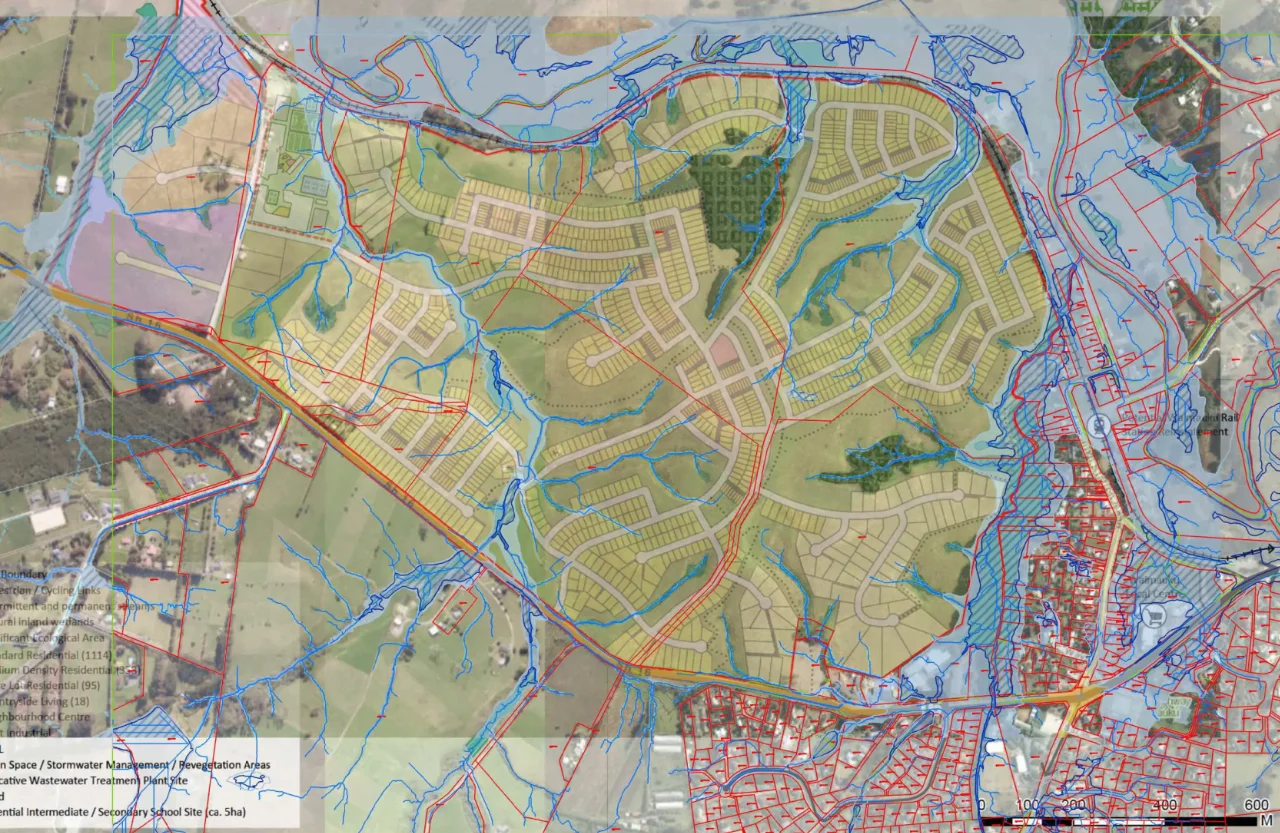
Waimauku West maintains their development is “flood neutral” meaning any event larger than a 10-year rain fall with an Annual Exceedance Probability (AEP) of 1% will flow directly to the river which will already be in flood. The Resource Management Act (RMA) allows that scenario to occur.
AEP of 1% means that the flood volumes are modelled on a ten-year rainfall event happening 1% of the year, so the consent would be granted on the basis that 3.65 days a year the catchment can experience a 1 in 10 year rainfall event where all stormwater will bypass storage devices within the development and flow unfiltered and unrestrained directly to the Kaipara River.
1 in 100-year events are modelled the same way – it is acceptable under the RMA for the catchment to receive a 100-year rainfall event straight of the development to the river 3.65 days a year.
The development will turn 196 hectares of farmland into something like 80% impermeable surface, all that rain that would have soaked into the ground will now flow to the river.
Drafting note – it would be good to have some stats in here to show how many 10 year and 100 year events we actually get over say a 20-year period and to show the GIS map of the flood plain
Waimauku West should contain a 1 in 100-year event on their own land (they have an additional 800 hectares outside the proposed development they could utilise). The stormwater volume would be stored and its passage to the river delayed so it won’t add to the flooding.
To enable that approach, Council first need to produce an Integrated Catchment Management Plan (ICMP) and flood model as part of a wider flood prevention strategy before any further intensification happens within the catchment.
Economic Benefits
The fast-track act refers to the provision of much-needed housing.
The Council Economist was unconvinced of the benefits claimed by Waimauku West and the substantive application is required to expand on these claimed benefits.
Data from ANZ shows that there is no current short term nor medium term need for the housing proposed under the application. There are already seizable portions of undeveloped urban zoned land in Auckland. There is no need to convert highly productive farmland into urban lots.
When you look at the graphs below and analyse the demand supply curve over the past quarter-century the reality is that we seldom have a real shortage of dwellings and the abrupt spikes are short term and over reported in the media whilst being weaponised by politicians.
Fundamentally the supply and demand paradigm is a false narrative.
The data below is from a 2026 ANZ bank report on housing supply and demand
Infrastructure
Waimauku West is a development isolated from all the infrastructure needed to support it, those elements are not part of the application, there is no plan for them and therefore no funding – roading, public transport, waste water, drinking water, flooding and stormwater are all concerns echoed in the written comments received from the consultation for referral.
The development would more than double the population of Waimauku with none of the roading and transport infrastructure to support the increase in vehicle movements